Legends, or Skate Nits?
Exclusive of Site Nacional de Skate
In defense of the Women who changed the History of World Skateboarding
Currently, the number of false “Skateboarding Associations” in Portugal that try to create a fictitious narrative that women have difficulty integrating into Skateboarding, and need to be “empowered” because they are not well received by male practitioners, is alarming. Nothing could be more false because women have been active in Skateboarding since the middle of the last century, and we Skaters are proud to practice the most inclusive sport on planet Earth.
We already had the opportunity to address this topic in our edition “Balance of 2021”, but we have now decided to do it again in a more in-depth way, as recently we have realized that there are people who call themselves “Legends of Portuguese Skateboarding” talking about this subject but were not even born when in 1965 a lady called Patti McGee was already skating here, but we will go on to that later…
Now, on the one hand, we have these “Legends” who write texts everywhere and make comments everywhere (and don’t even know how to recognize the maneuvers properly) but try to deceive children and young people to turn them into customers (students) of their Skate Schools (fiscally illegal).
On the other hand we have the (false) “Empowerment” imported from Brazil by people who very cleverly realized that to receive subsidies/financing from the Portuguese State they simply need to create a “Feminist Association” embracing this cause which is indeed noble, but as this problem does not exist in Skateboarding then these entities themselves are promoting hate speech, in order to justify the need for their existence.
This article therefore has a special dedication for all of you who try to cover up the History of Women in Skateboarding, or carry out a kind of Historical Revisionism to justify the existence of your “Associations”.
We will not allow the History of Skateboarding worldwide (especially that of Women) to continue to be distorted to serve your financial interests.
We will not allow you to invent feminism/machismo/homophobia in Portuguese Skateboarding to make it your job or business that you were unable to find any other way.
We will not allow your “movements” to create false discriminatory environments in skateparks, as all races, sexes, creeds, etc., have always been, are, and will be welcome.
That said, let’s start the History lesson and talk about the first woman who made a difference, Patti McGee.
For many who think that the first person to appear on a magazine cover was a man, they cannot be more mistaken, it was a woman, Patti McGee performing a Handstand, in Life magazine which came out on May 14, 1965.

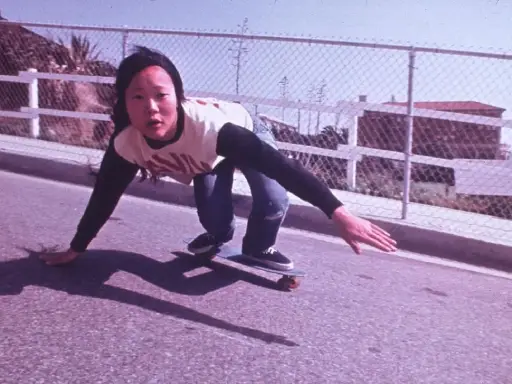
In the 70s era, Peggy Oki was the only woman in the legendary Dogtown Z-BOYS team, she was even discriminated against in competition by competitors of the same sex, because she skated like a man and aggressively like all the Z-BOYS. Thus becoming the first female “shredder” in world Skateboarding.
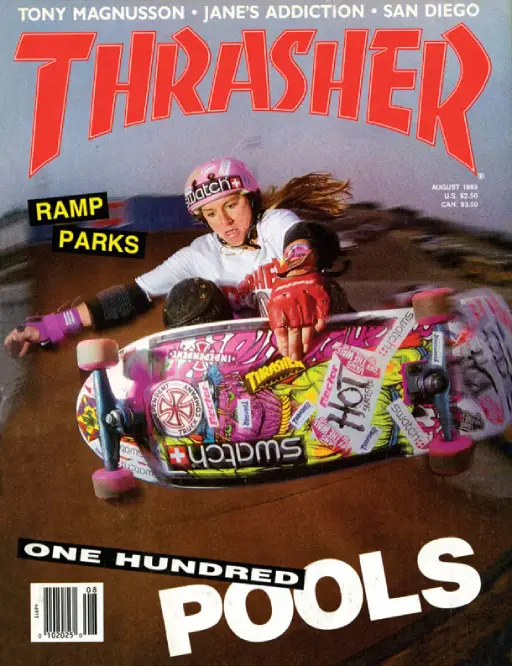
In August 1989, Cara-Beth Burnside appeared on the cover of Thrasher Magazine doing a Front Side Air at Half Pipe.
Christian Hosoi even said in several interviews that at first they thought it was a man, but when they saw it was a woman, they were amazed at the enormous talent she had, thus becoming the first “shredder” in Vert, and the first woman to appear on the cover of a skateboarding magazine.
After a career as a professional Snowboarder (she was part of the first US Olympic Snowboard team in 1998), Burnside convinced ESPN to host a women’s demo at the 2002 X-Games. This was a big step forward for women’s skateboarding, the following year the first X-Games women’s Vert event took place.
In 2005, the prize money was equal for men and women for the first time, and she was the first woman to own a Pro Model skate shoe.
In 1996, Toy Machine, in the video “Welcome To Hell”, introduced us to Elissa Steamer, with her completely destructive street part. In 1998 after the Slam City Jam in Canada, Toy Machine gave her her first Pro Model, thus becoming the first woman in the world to have a Pro Model board.
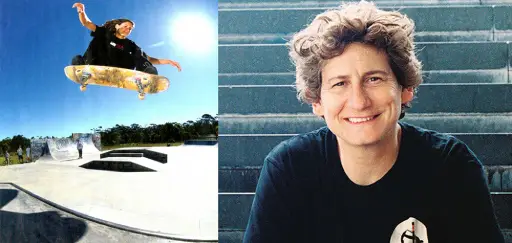
On November 21, 2009, Lyn-Z Adams Hawkins became the first woman to do a McTwist (540), at the Quicksilver Tony Hawk Show in Paris.
At 15, she became the first woman to skate the Mega-Ramp and the second youngest to win a gold medal in the X-Games.
She skates Vert, Bowl, Street and Mega-Ramp, has eight X-Games medals, and is without a doubt one of the best skaters of all time.

Hillary Thompson is the world’s first transgender skateboarder. At age 19, she started taking hormones to become a woman.
I skated a lot before I started the transition. The increase in estrogen in hormones meant a decline in muscle mass, so he had to relearn tricks to adapt. But they didn’t stop accepting her because of the sex change.

Leticia Bufoni was the first woman skater to be sponsored by Nike SB, the first to have a cover in The Skateboard Mag in October 2015.
In 2009, she won the Maloof Money Cup, winning a prize of 25 thousand dollars, not to mention her history of victories in the X-Games:
- 2010 Los Angeles 2° – Silver
- 2011 Los Angeles 3° – Bronze
- 2012 Los Angeles 2° – Silver
- 2013 Foz do Iguaçu 1° – Gold
- 2013 Barcelona 1° – Gold
- 2013 Los Angeles 1° – Gold
- 2014 Austin Austin 3° – Bronze
- 2017 Minneapolis 3° – Bronze
- 2018 Noruega 1° – Gold
- 2018 Sydney 2° – Silver
- 2019 Shanghai 1° – Gold
- 2021 Los Angeles 1° – Gold
And she still continues to win titles today, being one of the best women in world skateboarding, she is a true title-winning machine.